It’s weird, it’s weightless, and it’s wonderful. Here is the honest truth about the physical and mental side of breathing underwater.
⚡ The Short Answer
Is it hard? Physically, no. Mentally, it takes a few minutes to adjust.
Do you need to be an athlete? No. If you can walk and breathe, you can likely dive.
Do you need to be a strong swimmer? You need basic comfort in water, but you don't need to be an Olympic swimmer.
If you have never breathed underwater before, it is normal to feel nervous. At TDB Semporna, we see hundreds of first-time divers every season. The number one thing they say when they surface isn't "that was hard," it's "why didn't I do this sooner?"
Here is a realistic breakdown of what happens to your body and brain during your first dive experience.
The Mental Game: "My Brain Says No"
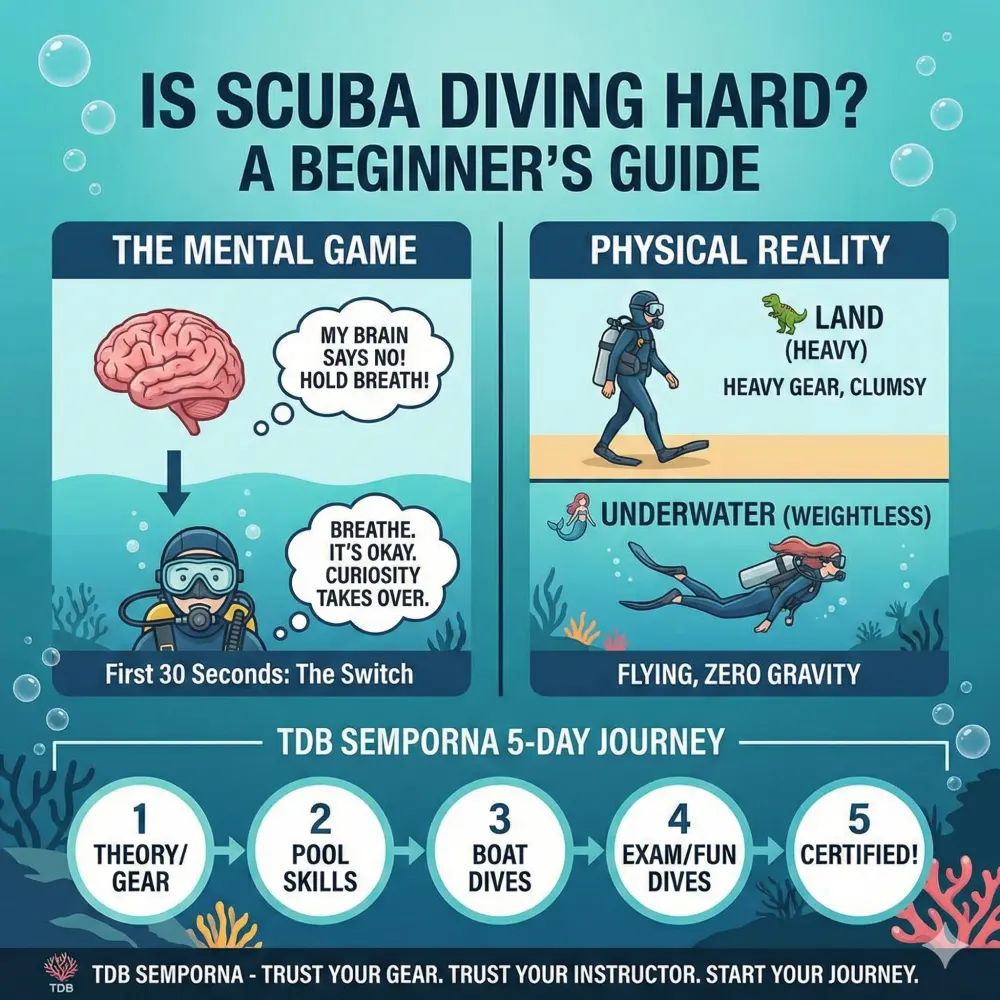
The hardest part of scuba diving happens in the first 30 seconds. When you lower your face into the water, your mammalian instinct kicks in. Your brain shouts: "We are underwater! Hold your breath!"
But in diving, the golden rule is never hold your breath.
You have to consciously tell your brain: "It is okay. I have air. Breathe in." This mental switch usually takes 3 to 5 breaths. Once you realize the air is flowing smoothly, the panic vanishes, and pure curiosity takes over.
The Sensory Shift: How the World Changes
It isn't just breathing that changes. Your senses adapt to the underwater world in fascinating ways:
- Vision: Water acts like a magnifying glass. Everything looks 33% larger and closer. That clownfish? It looks huge!
- Sound: Sound travels faster in water. You won't hear directions, but you will hear the rhythmic sound of your own breathing and the "click-click" of fish eating coral.
- Communication: Since you can't talk, we use Hand Signals. A "Thumbs Up" actually means "Go Up" (surface), while the "OK" sign means... well, everything is okay!
👂 Pro Tip: The "Pop" (Equalization)
The most common physical challenge is ear pressure. As you go down, you must "equalize" (pop your ears) just like on an airplane. We teach you to do this early and often—before your ears even hurt. If you can pinch your nose and blow gently, you can dive.
Physical Comparison: Land vs. Water
Your Journey: TDB's 5-Day Open Water Timeline
One reason people find diving "hard" is because they are rushed. At TDB Semporna, we spread our Open Water Course over a relaxed schedule so you can master the skills without stress.
-
1Theory & Equipment Class We start on dry land. You will meet your instructor, watch the PADI videos, and get fitted for your wetsuit and fins. You'll learn how the scuba unit works (it's simpler than it looks!) and get comfortable with the gear before getting wet.
-
2Full Day Confined Pool Session This is where you build confidence. In our shallow confined water, you will practice essential safety skills: clearing water from your mask, recovering a regulator, and—most importantly—perfecting your buoyancy so you can hover effortlessly.
-
3Boat Dives: Open Water 1, 2 & 3 Your first ocean adventure! We take the boat to a calm, protected reef. You will repeat the skills you learned in the pool, but this time you'll be surrounded by tropical fish.
-
4Open Water 4 + Fun Dives (2 Dives) The final "exam" dive (OW 4) happens in the morning. Once you pass, the pressure is off! You celebrate with 2 "Fun Dives"—no skills, no tests, just exploring the Semporna reefs as a newly certified diver.
-
5Check Out You leave with your diving license (valid for life!), your digital logbook filled with memories, and a new community of dive buddies.
Not Sure If You're Ready to Commit?
You don't need to sign up for the full 5-day course immediately. Try our "Discover Scuba Dive" (DSD)—a half-day experience with no exams, just fun.
View DSD PackageBeginner Diver FAQs
Can I dive if I wear glasses?
How deep will we go?
What if I can't swim well?
Will I feel claustrophobic?
The Verdict?
Scuba diving isn't "hard"—it's just different. It requires you to trust your gear and your instructor. Once you take that first breath underwater and see a turtle gliding past you on the Semporna reef, the fear disappears. You'll only wonder why you waited this long to start.